



Insight Focus
Aluminium markets strengthened in May. LME prices reaching four‑year highs as supply disruptions outside China kept physical markets tight. China remained relatively well supplied, widening global price differentials and driving arbitrage opportunities. Trade flows shifted to offset Gulf supply losses, though constraints limited efficiency. Overall, ex‑China scarcity and ongoing geopolitical risks continue to underpin a structurally tight global aluminium market.
Prices Jump, Then Consolidate
Over the past month, global aluminium stayed elevated near four-year highs, even after some late-May profit-taking. LME aluminium rose from roughly USD 3,480/tonne at the start of May to around USD 3,675/tonne at the end of the month. By June 8, benchmark prices were still around USD 3,595/tonne, up about 44% year on year.
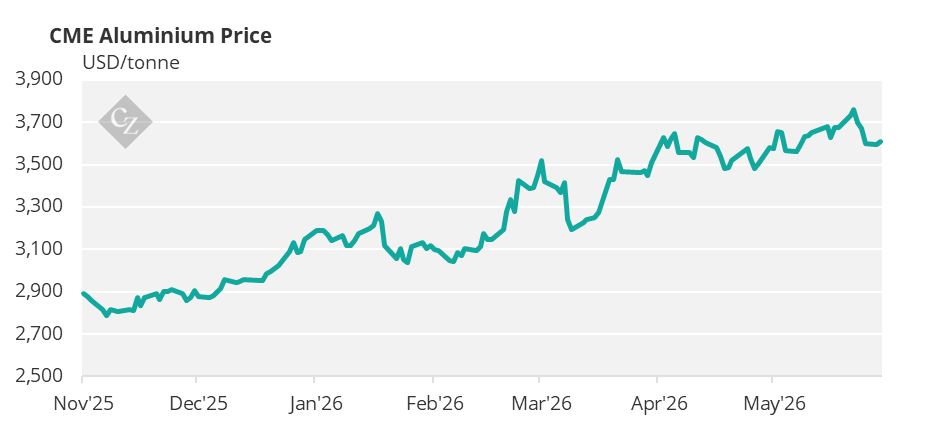
The core driver remained ex-China physical tightness. Disrupted Middle East supply, constrained Gulf exports through Hormuz and very low deliverable inventoriesv kept nearby premiums firm even when ceasefire headlines triggered periodic pullbacks.
Differentials and Premiums Surge Across Regions
Regional price differentials widened sharply through May, reflecting acute divergence between tight ex-China markets and relatively looser Chinese fundamentals. The SHFE/LME ratio fell from 7.03 in April to 6.66 in May, signalling persistent LME outperformance and highlighting the widening spread between domestic and international prices.
Japanese and global premiums continued to rise through May, reflecting tightening availability of seaborne metal, although confirmed quarterly settlement figures remained anchored to earlier negotiations. More importantly, spot indicators showed clear upward pressure. Japan’s spot premiums increased during May, while premiums in both Europe and the US continued to climb, reinforcing the global ex-China supply gap.

At the same time, exchange-based indicators highlighted the same tightening. The LME cash-to-3M spread widened sharply to around USD 92.53/tonne by month-end, up from roughly USD 29/tonne at the start of May, signalling strong demand for prompt physical metal and rising scarcity in deliverable units.
May data shows that while headline quarterly benchmark settlements were largely set earlier and spot premia and spreads continued to move higher across all major import regions, with Europe, Japan, and the US experiencing sustained upward pressure due to ongoing supply disruption and low inventories.
Trade Flows Re-Route to Fill the Gap
Trade flows are being redrawn around missing Gulf tonnes and tariff barriers. With Gulf smelters damaged and shipping through Hormuz impaired, Chinese semis and primary exports have become a bigger balancing mechanism for ex-China shortages, even though trade barriers still limit how much of that metal can flow directly into Western markets.
SMM said May’s market logic included “accelerating export transmission,” while Chinese prices stayed relatively less supported because domestic inventories remained ample compared with overseas markets.
Upstream raw-material trade is also shifting. According to reports, Guinea exported 60.9 million tonnes of bauxite in January-March, up from 48.6 million tonnes a year earlier, with China taking more than 70% of Guinea’s exports. In March alone, China imported 18.12 million tonnes of Guinean bauxite. That shows how strongly China is pulling in raw materials to sustain production growth while the rest of the world struggles with refined metal availability.
Arbitrage Favors LME Over SHFE
The clearest arbitrage in the market has been cross-exchange rather than simple regional freight arbitrage. SMM described “selling SHFE and buying LME” reverse arbitrage as the core market trade in May, because overseas fundamentals stayed structurally tighter while China’s inventory drawdown remained slow.
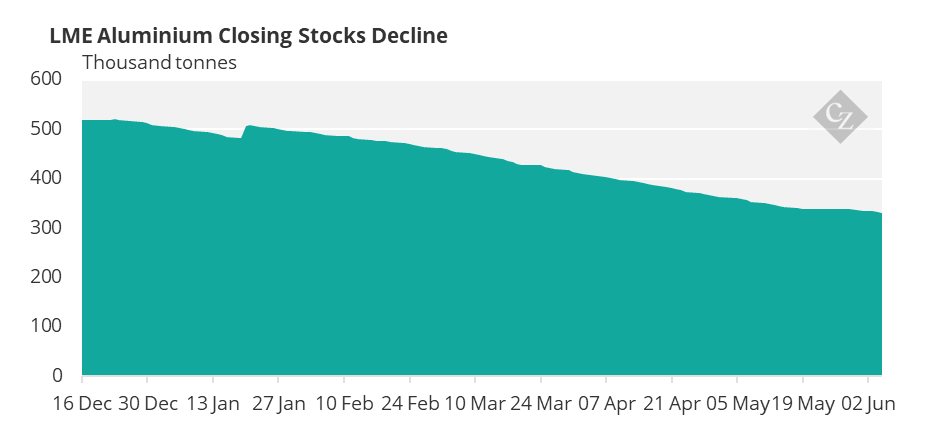
The economics are supported by inventory and spread structure. LME stocks fell from about 363,000 tonnes at the start of May to 338,000 tonnes by month-end. That backwardation signals strong spot demand for immediately deliverable non-Russian metal, but it also raises roll costs, meaning the trade works best for nimble positioning rather than passive carry.
Source: LME
For physical traders, the other “arbitrage” remains destination driven. Metal is incentivized toward the US and Europe, where tariffs and shortage premia create much higher all-in prices than in Asia, although sanctions, product form requirements and origin rules limit how fully those price signals can be exploited.
Supply Shock Meets Uneven Demand
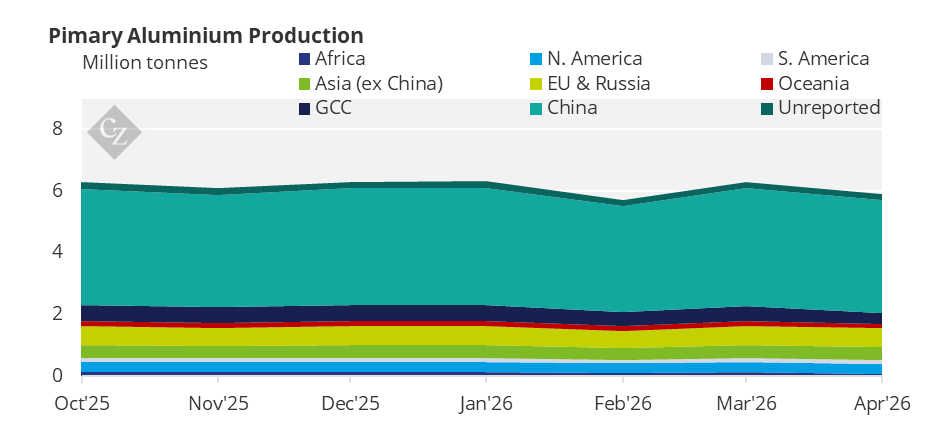
On the supply side, the market still looks fundamentally tight outside China. IAI data show global primary aluminium output was 5.922 million tonnes in April, of which 3.678 million tonnes came from China and only 330,000 tonnes from the Gulf Cooperation Council.
Source: IAI
S&P Global said Gulf daily production in April fell to 62% of pre-war levels, helping stall global output growth. In April, Wood Mackenzie said it expects a 2026 market deficit of up to 3 million tonnes, with global output down 3% this year, and Reuters highlighted even more bearish deficit talk of up to 4 million tonnes under severe disruption assumptions.
Demand is uneven rather than collapsing. China’s downstream demand has been softer than traders hoped, which is why SHFE has lagged, but India and China are still expected to lead global aluminium demand growth in 2026, with processed aluminium demand seen rising 1.8% year on year to 107.3 million tonnes.
At the margin, the shortage is also boosting substitution into scrap. The global primary deficit and price spike are increasing scrap demand and prices, especially in Europe.
The bottom line for June is that ex-China aluminium remains a tight, premium-driven market. Unless Gulf supply normalizes materially and inventories rebuild, the path of least resistance for LME strength, wide regional differentials and selective arbitrage into high-premium destinations still looks upward—even if headline peace news causes intermittent corrections.
Source : https://www.czapp.com/analyst-insights/aluminium-prices-tighten-ex-china-softer-china/

